Associate Professor of Environmental Health and Safety Engineering
John and Willie Leone Department of Energy and Mineral Engineering
College of Earth and Mineral Sciences
The Pennsylvania State University, University Park, PA, USA
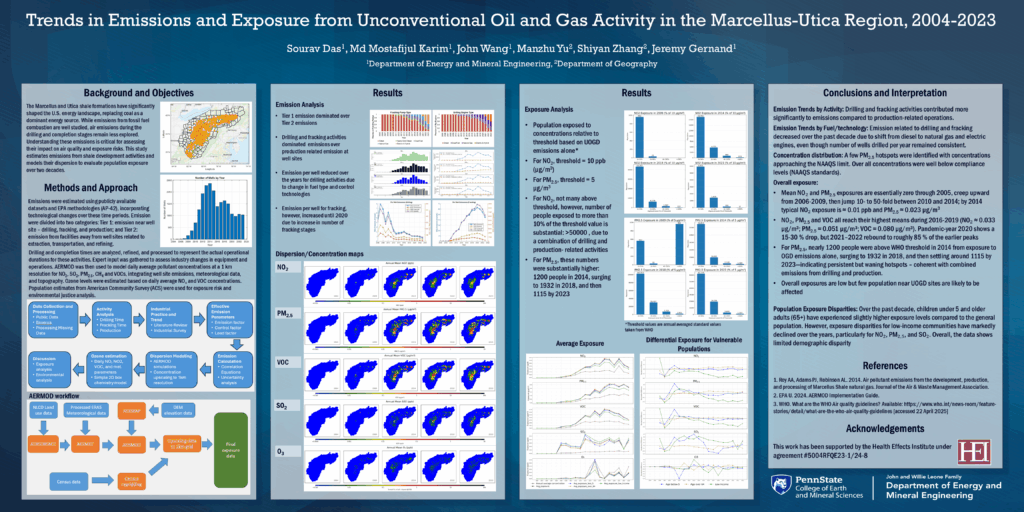
In a poster our team is presenting today at the Health Effects Institue Annual Conference, our preliminary research shows that the air emissions intensity of Marcellus area gas wells is decreasing with peak exposures occurring between 2014 and 2021 depending on the pollutant. While technology has been improving to reduce emissions and leakage, lateral wells have been growing longer counteracting some of this benefit. In other regions of the US this is not necessarily true unless they are also installing equipment to capture natural gas.
I really think that the issue with successfully creating artificial general intelligence (AGI) is that human general intelligence doesn’t really exist and it may be a limitation of artificial or biological neural networks. People can be highly skilled, knowledgeable, and experienced, but never in all areas and rarely in more than 1-3 areas. And this may not only be because we don’t have infinite time to learn. Learning some skills is likely to degrade other skills.
Today is the final day of the semester at Penn State, and I wish all our graduating engineering students, and especially those in our Environmental Systems Engineering program, good luck on your final exams, a wonderful culminating experience at graduation, and a successful start to your careers. May you go out and help make our world a better place.
Executive administrations have a large amount of discretion to block most new rules proposed by federal agencies since the Office of Information and Regulatory Affairs in the White House can review each new regulation and make a declaration that the new rule is too expensive or harms the national interest in some way. The US Congress can repeal regulations enacted in the last 60 days. Congress could also remove the authority of an agency to make certain kinds of rules. But the executive process for rescinding an existing regulation is more challenging.
The Administrative Procedure Act requires that the removal of rules follow the same process as the enactment of new rules. So, the same kind of scientific and economic evidence required to justify a rule banning a certain chemical or requiring measurements of radiation exposure for x-ray technicians would be required to justify the rule’s removal. There are certain cases where rules end up being more expensive than originally envisioned, and these could be valid candidates for possible review and revision, but the evidence could take years to collect, and the data would often not support complete removal of the rule, just a partial relaxation of one. This makes rule recissions unlikely to be completed, and unlikely to hold up under court review.
I just came across the linked paper [https://doi.org/10.1177/0019793920931495] that analyzed the impact of MSHA flagrant violations levied on US mines on worker productivity in those mines. The author, Ling Li, found that productivity was reduced after flagrant violations were issued and that these costs together with the associated fines outweighed the benefits from reduced safety incident rates that resulted after these fines were levied.
The MINER Act that authorized the MSHA flagrant violations rule (fines of more than $220,000) was passed in 2006. Li’s paper confirms that mines experiencing a flagrant violation meaningfully improved safety and reduced injuries after being cited but also finds that the tons of coal per hour produced at those mines also decreased resulting in a total cost impact 30% greater from decreased production than would have been paid to treat injured workers.
I think there are a few weaknesses with this conclusion that could be addressed in future analyses.
First, all mines are potentially affected by publicized flagrant violations, not just the mine that received it, since these are made public, and other management teams are likely to pay attention and update procedures where necessary to avoid a similar fine themselves. An analysis that considered the industry as a whole rather than the effects on individual mines would be more relevant to the effectiveness of the regulation.
Second, there are potential explanations for reduced coal output beyond safety-related changes in response to a fine from MSHA including mine age resulting in depleting coal seams, or reduced investment by the owner to focus on other sites, or a loss of more experienced workers. These and other alternative explanations for the decline in productivity need to be investigated rather than assuming it is the result of the response to the flagrant violation.
Third, the costs of safety incidents were estimated at a flat rate of $69,363 each, and there weren’t enough fatalities occurring (thankfully) to be able to assess whether these were reduced as well. This is important since the policy analysis of the rule was heavily dependent on reductions in fatalities which have values around $10 million each. However, fatalities usually result from the same sorts of events that cause less severe injuries, so it should be possible to assess the expected number of reduced fatalities based on the observed reductions in more common injuries.
Lastly, the comparison groups of mines with and without flagrant violations are matched via another mine at the shortest distance rather than matching mine characteristics such seam height, surface or underground, equipment employed, mine size in terms of overall production or employment, and so on. These attributes can dramatically change the baseline of risks to workers. Our group has some previous research on this topic: https://doi.org/10.1016/j.ssci.2018.10.005. While most mines nearby are likely to share some of these characteristics, they need to be explicitly included in the analysis as predictors, otherwise conclusions could be misleading.
New article in The Conversation: pause on enforcement of silica exposure rule is unlikely to do much to aid the mining industry and leaves the costs of exposure to rest on families and American taxpayers.
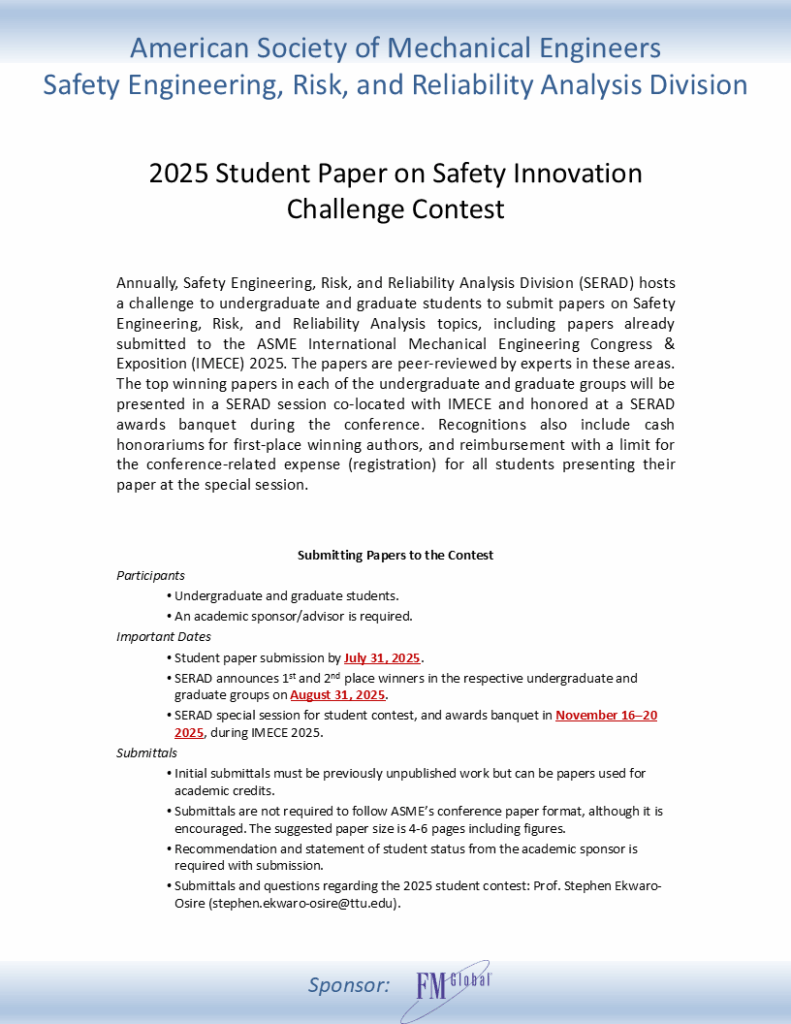
Graduate or undergraduate students with research or design projects related to Safety, Risk or Reliability Analysis are encouraged to submit their work to the Safety Innovation Challenge, a student award program sponsored by the ASME Safety Engineering, Risk and Reliability Analysis Division (SERAD). Winners will be honored at the annual SERAD awards dinner, which will be held in Memphis, Tennessee, USA in November (though attendance is not a requirement to receive the award). More details in the attached flyer.
Having accurate data on the harms faced by Americans is critical to making our country’s people safer regardless of how you believe we should go about that (through government regulation or some kind of market-oriented mechanism or doing nothing due to bigger priorities). I would be willing to listen to an argument that some kind of non-profit could do this job, but I’m skeptical, and in any case, such an organization doesn’t yet exist. Researchers can try to fill the gap, but their/our time better spent testing potential solutions rather than just trying to keep up with tracking statistics. | CDC injury prevention team faced major cuts, putting critical work at risk : Shots – Health News : NPR
Congratulations to Leiyu He (left), Sean Naughton (not pictured), and Miranda Quezada (right) for winning the 2025 Student Merit Awards in Environmental Systems Engineering for their records of outstanding academic achievement. We also congratulate Katie Siedel (not pictured) for being awarded the Good Citizenship Award in Environmental Systems Engineering for her record of university and community service.
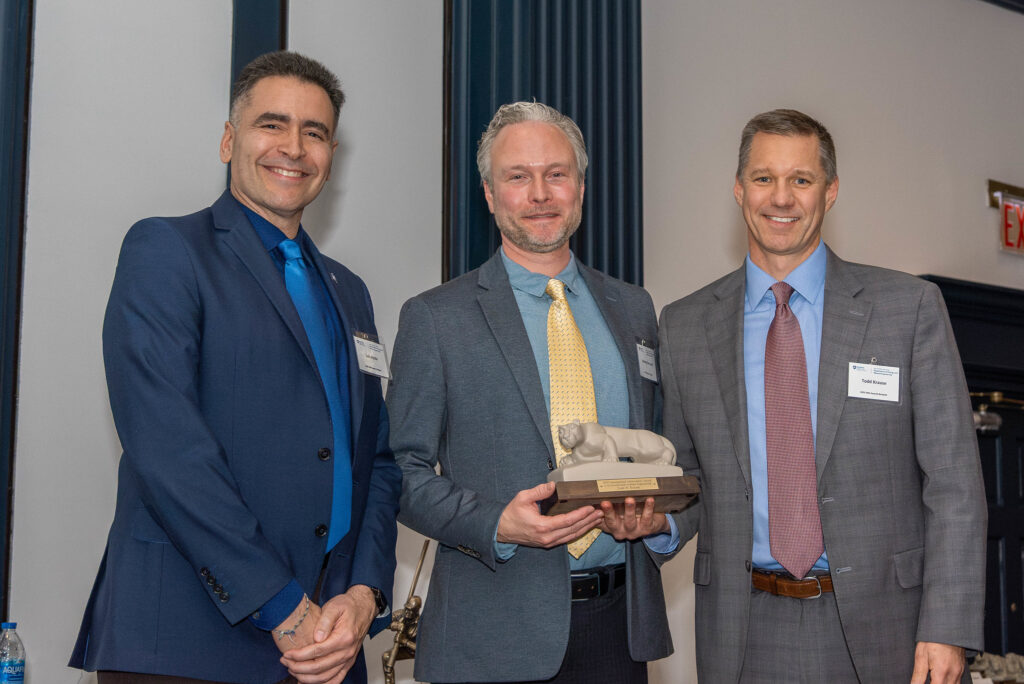
Congratulations to Todd Krause (right) for being awarded the 2025 Distinguished Alumni Award in Environmental Systems Engineering by the Penn State’s Department of Energy and Mineral Engineering. Also pictured: Luis Ayala (left, EME Department Head), and Jeremy Gernand [me] (center, Environmental Systems Engineering Program Chair).
Yesterday (January 23) was NASA’s Day of Remembrance (https://www.nasa.gov/dor/) commemorating the lives lost in the Apollo 1 fire in 1967, the Challenger explosion in 1986, and the Columbia disaster in 2003.
I was in elementary school at the time of the Challenger explosion located just a few miles away from Mission Control, and though we were not watching live, we all filed into the common room to watch the news on the television once the explosion had happened and word had spread to the teachers (the inclusion of the “civilian” teacher, Christa McAuliffe, on that launch struck many deeply as we could identify her with people in our lives personally). When Columbia burned up on re-entry, I was employed at Johnson Space Center as a Safety and Mission Assurance Engineer, not responsible for shuttle vehicle safety (I oversaw internal ISS systems supporting crew health), but I knew and interacted with those who were. I participated in a very small way in the investigation into that event and still keep a copy of the final report on my bookshelf. I had seen one or two of the Columbia astronauts in meetings but not interacted directly with them.
One common lesson emerged from each of these events: we could do better. When risk was abstract, we accepted it, we put on a brave (or sometimes cavalier) face, we were more optimistic than our data could justify. Afterwards, we saw mistakes, we found our skepticism and critical thinking skills again, and we resolved to not let ourselves be led astray. These outcomes were not inevitable, even as human space exploration remains filled with hazards that we struggle to mitigate. The causes of the actual losses of life in these events were all squarely under our control.
Beyond those general lessons, what sticks with me personally is this: we read the stories of these astronauts and laud their bravery and sacrifice; we empathize with their families and the loss of a spouse, parent, friend, child, or colleague; we invest millions of dollars to reduce the chance that something like this happens again, and we judge the cost to be worth it. Over 5,000 Americans died on the job in 2023, and those losses impacted their families and friends and coworkers and organizations just as severely, yet we are unlikely to have the chance to hear their stories and extend our empathy to their friends and family, and we will not invest millions of dollars in ensuring their fate is not repeated. Honestly, we lack the resources necessary to do that even as wealthy as we are, but this remains true: we could do better.
A new study from the Environmental Defense Fund indicates that 72% of methane emissions in the Permian Basin come from small sources (leaks rather than major ruptures or releases) <https://apnews.com/article/methane-gas-texas-permian-basin-satellite-climate-81b9cfea311275806c6fbf8621f821c2>. This is a sign of progress, though it means further improvements will be more labor intensive. Methane has significant climate change impacts, and while not toxic itself, it can lead to increased human exposures to ozone and other toxic chemicals created due to reactions in the atmosphere. Reducing methane emissions will have concrete health benefits to people who live nearby.
My group is currently working on a study of Marcellus area air emissions including methane, NOx, SOx, and PM. While the number of wells is less than in the Permian, this remains a significant source of regional air emissions. We hope to publish results later in 2025.
“On average, the rule would prevent an estimated 1.4 fatalities and 3.9 injuries per year, resulting in annual safety benefits of $14.2 million in 2021 dollars. To meet the safety standards, [transit agencies] and [state safety oversight agencies] would incur an estimated $2.0 million in start-up costs plus $11.3 million in ongoing annual costs.” (https://www.federalregister.gov/documents/2024/03/25/2024-06251/rail-transit-roadway-worker-protection)
The House Space and Aeronautics subcommittee recently held a hearing on commercial space utilization and public safety (https://science.house.gov/2024/9/space-aeronautics-subcommittee-hearing-risks-and-rewards-encouraging-commercial-space-innovation-while-maintaining-public-safety). A key issue at this hearing was the tension between preserving public safety as a priority and also facilitating innovation and more rapid changes. You can read the chair and witness statements at the link above. The increase in the pace of commercial space launches and overall utilization puts pressure on the existing regulatory apparatus to appropriately review these operations, and it certainly seems like increased investment whether funded through general appropriations or through increased fees on the part of the launch service companies would be appropriate to not compromise the historically high safety standards in this industry.
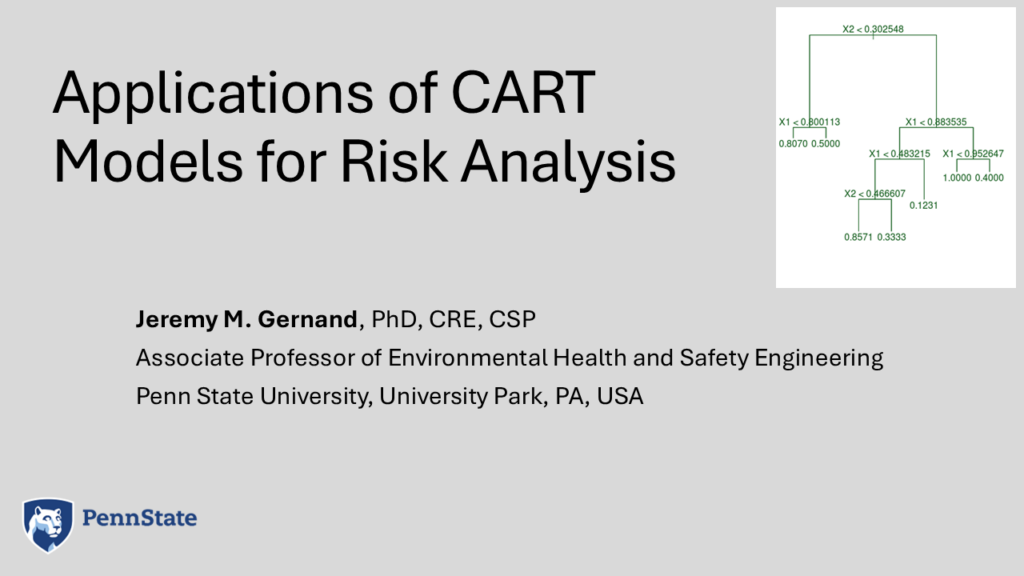
I had a great time presenting a lecture on the application of CART machine learning models to risk analysis at the Civil Aviation University of China yesterday. Many thanks to my hosts. I look forward to further opportunities for collaboration in the applications of advanced data analytics to questions on risk analysis and management.
CART models have several valuable characteristics for risk analysis including learning more effectively from incomplete data, identifying critical thresholds, identifying conditionally important variables, and interpretability. I have employed CART models and random forest models in a variety of risk-related applications from mine worker safety to nanoparticle toxicity, and always looking for more that they can do.
A thing that doesn’t get talked about enough is the accompanying benefits of reducing CO2 emissions. This new paper does that and puts a dollar value on those benefits: https://doi.org/10.1016/j.egycc.2024.100165.
When we stop emitting CO2 to the air, we also stop emitting a lot of other pollutants that increase people’s risks of cardiovascular disease and cancer and other problems. This analysis estimates $65 to $250 billion in annual benefits from this reduction in non-CO2 emissions, for only partly achieving zero emissions goals. That’s big.
While it feels nice after the end of Daylight Saving Time (DST) in the Fall to wake up or head into work or school with the sun and not in darkness, changes into and out of DST are both associated with increases in vehicle and other forms of home and work accidents (https://doi.org/10.1016/j.aap.2017.11.029) (https://doi.org/10.1016/j.aap.2017.11.029).
The reasons for DST are no longer pertinent in our internet-connected world and this applies to time zones as well. We can make our own local decisions on school start times and business hours and make national and international coordination easier. Permanent DST (or ending DST) is just a necessary start, though one we should implement immediately. The human costs of these changes are unnecessary, and we owe it to each other to end them.
The biggest risk to kids on Halloween comes from collisions with automobiles. With all the excitement of friends about in the neighborhood after dark and wearing special costumes, it can be difficult for cars to see children and challenging for kids to see and recognize the danger from cars. Adults need to take special care to supervise street crossings even for kids who are “too old” to normally need such supervision. Finding ways to make costumes reflective, incorporating light features into costumes, and taking action as a neighborhood to slow local traffic on this one evening are valuable mitigations that can help prevent serious injuries. Being safe is more fun! <https://www.thefloridalawgroup.com/news-resources/5-halloween-accident-statistics-you-should-know-5-halloween-safety-tips-for-children-parents-this-weekend/>
In this undergraduate-led research project that we concluded in 2020, we found small quantities of nanoparticles in the breathing zone during application of aerosol mineral sunscreens recommended for use on children (https://doi.org/10.1007/s41810-020-00079-x). Overall, 85% of the particles by count had diameters less than 100 nm, and this project captured direct images of several different particle types with some clearly the product of mineral grinding processes, while others show signs of having been manufactured. Interestingly, plume sizes for the 3 tested products were widely different with some extending more than 2.5 m from the pressurized can. There seems to be little risk under the particular scenario we tested, as the highest measured concentration for all particles was 0.8 micrograms per cubic meter, and the lowest recommended exposure limit for titanium dioxide nanoparticles (from NIOSH) is 300 micrograms per cubic meter.
Hawaii and other states and localities are in the midst of considering new rules and laws about the operation of electric bikes (ebikes) [https://www.hawaiinewsnow.com/2024/10/23/officials-brainstorm-new-rules-e-bikes-improve-safety-amid-rising-accidents/]. As an ebike rider myself, I am both encouraged by and a little leery of new regulations for ebikes. Many jurisdictions, however, are stuck with rules developed for gasoline powered mopeds more than 40 years ago. Ebike technology is a potentially excellent way to increase mobility and reduce car use at the same time by making it easier to make trips on bicycle regardless of physical fitness. But ebikes are heavy, and children and others can easily get to speeds and situations that are beyond their experience and capabilities and put themselves at risk. Prioritizing facilitating this transportation method, while keeping riders away from cars first, and separated from pedestrians second, can help our towns and cities get the most out of this technology.